Deze gids is nog niet in het Nederlands vertaald en wordt daarom in het Engels getoond.
Roughtail Rock Agama
Laudakia stellio
Laudakia stellio is a sturdy, spiny rock agama from the eastern Mediterranean, grey to brown with pale, star-shaped spots and a tail in distinct rings. It is diurnal, a good climber, eats both insects and plants and grows to 30-35 cm. It needs a dry enclosure with a very hot basking spot, UVB and plenty of stones to hide in.
Over de soort
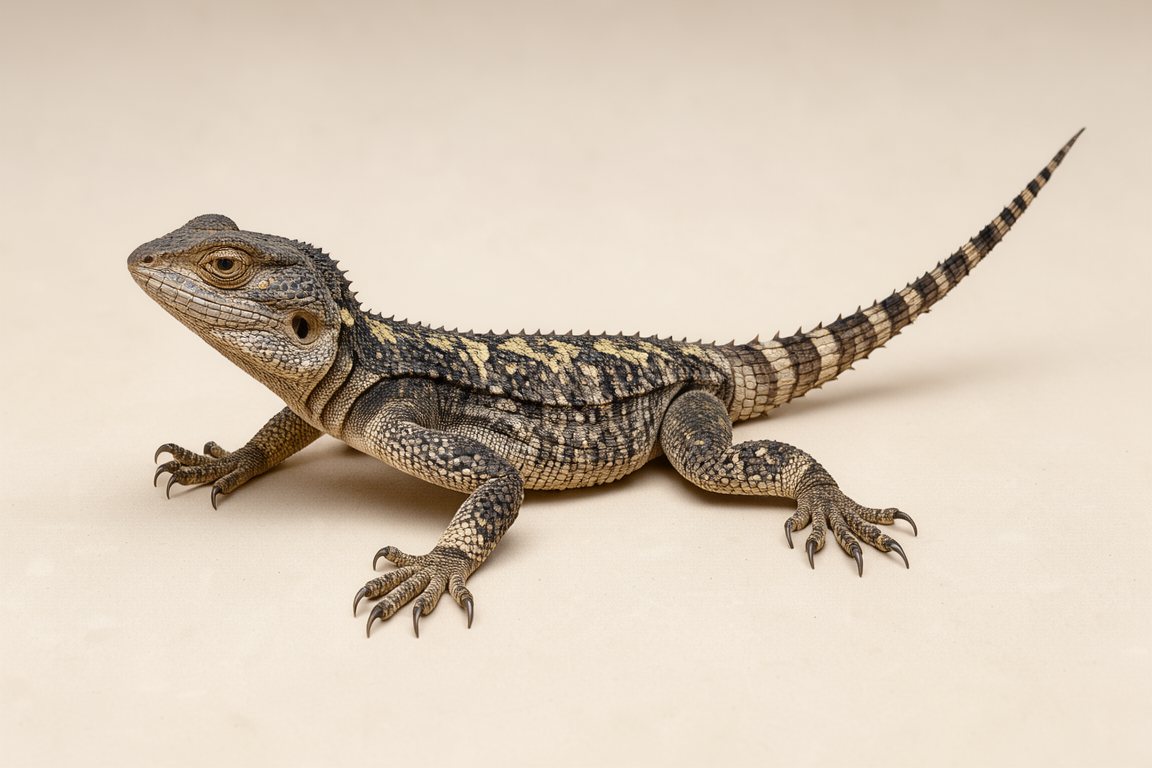
Laudakia stellio is a sturdy agama with a broad head, strong legs and coarse, keeled scales, especially on the back and tail. The base colour is grey to brown with pale, cream-yellow or orange spots that often merge into bands. The tail is divided into distinct segments, each with two whorls of scales. The colours change with temperature and mood, and in the breeding season the male acquires stronger colours on the head and throat. The species name probably refers to the small, star-like spots.
Adults grow to 30-35 cm including the tail; the body measures no more than about 13 cm from snout to vent, and the tail is roughly one and a half times as long. Males are larger than females and have a larger head. The animal is fast, climbs well and is shy: when in danger it disappears down a crevice between the stones.
The species was described by Linnaeus in 1758 and has changed genus several times: Agama stellio, Laudakia stellio Stellagama stellio in 2012 and, since 2022, Laudakia stellio again. The name Stellagama stellio is still seen in the trade and in older literature. DNA studies have shown that the species in the old, broad sense is a species group. The population on Cyprus now belongs to Laudakia cypriaca, and the populations in Egypt, Israel, Syria and Lebanon to Laudakia vulgaris. Animals in the trade are often the form brachydactyla, which is today regarded as part of L. vulgaris. Care is the same for the whole group, but information in older literature may refer to the related species.
The species is an exciting agama for anyone who wants a smaller and more rock-dwelling animal than Pogona vitticeps. It tolerates calm handling, but is not an animal to be picked up every day.
Verspreiding en leefgebied
Laudakia stellio lives in the eastern Mediterranean: in Greece, in western, central, southern and south-eastern Turkey and in Jordan. In Greece it occurs on many islands in the Aegean, including the Cyclades (Naxos, Paros, Mykonos, Delos), Rhodes, Kos, Samos, Lesbos and Chios, as well as around Thessaloniki and on Corfu. Several of the island populations, including that on Corfu, are probably due to people having brought the animals with them. The species has also been introduced to Malta.
Older maps give the species a far larger range, which also includes Cyprus, the Levant and Egypt. Those populations are now regarded as closely related species. The map shows the current delimitation.
Natuurlijk verspreidingsgebied: Griekenland en Turkije. De stippen zijn waarnemingen van GBIF en kunnen dieren in gevangenschap en geïntroduceerde populaties bevatten. Bekijk de soort op GBIF
Leefgebied
Laudakia stellio lives in open, dry and stony country: rocky slopes, stone walls, ruins and rock outcrops, but also in scrub and in gardens and villages with walls. It likes to sit on stones, walls and tree trunks, where it basks, and retreats into crevices when in danger.
The climate is Mediterranean, with long, dry and hot summers and mild, wetter winters. The animal maintains a body temperature of about 34 °C when active and in a temperature gradient selects 33-38 °C. It hunts both from a lookout post and actively and eats mostly insects, but also snails, small snakes, frogs and fruit. In the wild it lives for up to about 7 years.
Verzorging
Het terrarium
An adult animal needs an enclosure of at least 100 × 50 × 50 cm (length × width × height). A pair or a male with a couple of females needs at least 120 × 60 × 60 cm. The species is active, so bigger is better, and the length determines how good a gradient can be created.
Use a substrate of sand mixed with a little soil, at least 5 cm deep, so that the animal can dig. Avoid coarse gravel and crushed shells; loose substrate can cause constipation if the animal swallows much of it. Remove droppings daily, and replace the substrate completely every 3-4 months.
Set it up with a flat basking stone of slate or other rock, stable stacks of flat stones, cork and hollow branches to climb on. At least two or three hiding places in different temperature zones is a minimum, and everything must be secure, so that nothing topples. The enclosure must be well ventilated and lockable, because the animal is fast. Drought-tolerant plants, real or artificial, give a sense of calm.
Temperatuur
Laudakia stellio needs a clear gradient. The basking stone should have a surface temperature of 40-46 °C, measured with an infrared thermometer, while the cool end is at 21-29 °C. This lets the animal keep its body at the 33-38 °C it prefers. Use a halogen spotlight in a ceramic fitting over a flat stone. Ceramic heaters and coloured bulbs are not suitable for the basking spot.
At night all heat and light are switched off, and the temperature may fall to 17-20 °C. If the room is colder, use a ceramic heater on a thermostat. Use a thermostat on all heat sources.
Day length can follow the season; see under Lighting. Whether the animal needs a proper winter rest is not documented; winters in the species' range are mild.
Luchtvochtigheid en water
Daytime humidity should be 15-35 %. Mist the walls lightly in the morning, so that the animal can drink droplets, because agamas prefer to drink droplets rather than from a dish. A heavy misting in the evening makes the humidity rise at night, as it does in the wild, but the enclosure must dry out again during the day, and ventilation must be good, because persistent damp causes respiratory infections.
Always keep a dish of fresh water in the enclosure, and scrub it every week or when it is dirty. Air that is too dry causes problems with shedding on the toes and tail tip.
Verlichting en UVB
Laudakia stellio is diurnal and basks a lot, so it needs strong light and UVB corresponding to Ferguson zone 3. Use a T5 HO tube of 10-12 % in a reflective fixture on the same side as the heat lamp. If the tube sits above a mesh, the basking stone should lie 25-30 cm below it; if it sits inside the enclosure, the distance is 35-40 cm. Check with a UV meter. The cool end must have shade.
Keep 10 hours of light in winter and 14 hours in summer, and switch off all lamps at night. An extra LED or fluorescent tube of about 6,500 K gives more light and helps the plants. Replace the UVB tube according to the manufacturer's instructions, usually every 12 months.
Voeding
Laudakia stellio is omnivorous, but insects make up the largest part of the diet. Offer a varied diet of well-fed insects, for example cockroaches, crickets, hornworms, silkworms and mealworms, and fresh greens such as dandelion leaves, kale, mustard greens, rocket and prickly pear pads (opuntia). Lettuce has a low nutritional value and is not used as a regular food.
Young animals get insects and greens every day. Adults get greens every day and insects every other day, as many as they eat in about 10 minutes. Dust the insects lightly with calcium; alternate between calcium with and without D3, and give vitamins once a week. Supplements are sprinkled on the insects, not on the greens.
Lees meer: Calcium, vitaminen en supplementen
Gedrag en omgang
Laudakia stellio is shy and fast, but usually tolerates calm handling. Never pick the animal up from above; lift it from below, and support the body and legs. Preferably let the animal climb onto your hand itself, and never take it out of a hiding place. Keep sessions short until the animal is at ease with you. Hand-feeding with tweezers builds trust.
Two males must never live together. Females can usually live together, and a male can be kept with one or more females when the animals are the same size and the enclosure is large enough. Provide many hiding places and several basking spots, and separate the animals if wounds appear.
Kweek
Geslachtsrijpheid en geslachtsonderscheid
Males of Laudakia stellio are larger than females, have a larger head and acquire stronger colours on the head and throat in the breeding season. The sex is easiest to see in adult animals in the season.
In the closely related L. vulgaris the smallest sexually mature animals are about 9 cm from snout to vent. The age at sexual maturity is not documented. Do not breed a female until she is fully grown and in good condition.
Paring
Mating in Laudakia stellio takes place in spring and early summer. The male defends his territory with head-bobbing, colour change and an inflated throat and uses the same signals when courting the female. Experience with mating in captivity is not documented. Introduce the male to the female in a spacious enclosure with many hiding places, keep an eye on them, and separate them if the female is wounded or stops eating.
Eileg en legsels
The female lays 4-10 eggs from May to July, in sandy soil or under stones. Clutches of up to 15-18 eggs belong to the closely related L. vulgaris. How many clutches a female lays per year is not documented.
Provide the female with a laying box containing 10-15 cm of damp sand where she can dig. Without a suitable site she may retain the eggs, which can become life-threatening. Give her plenty of food and calcium before and after laying.
Incubatie
The eggs hatch after 2-3 months. The incubation temperature is not documented for L. stellio; 26-30 °C is an estimate borrowed from the related Agama agama. Take the eggs up carefully without turning them, and place them in slightly damp vermiculite in an incubator.
The species has temperature-dependent sex determination, so the incubation temperature affects the sex ratio. Keep the temperature stable.
Opfok van de jongen
Newly hatched young need the same set-up as the adults: hiding places, a basking spot and UVB. Feed them daily with small insects, dusted with calcium, and finely chopped greens. Keep them apart from the adults, and separate the males in good time, because they become territorial. Growth and rearing in captivity are not documented in more detail.
Gezondheid en veelgemaakte fouten
Most diseases in Laudakia stellio are caused by mistakes in care. Typical problems are:
- Metabolic bone disease from too little UVB and calcium.
- Shedding problems from air that is too dry, especially on the toes and tail tip.
- Respiratory infection from too low a temperature or persistently high humidity.
- Constipation from swallowed substrate.
- Intestinal worms and other parasites. Quarantine new animals, and have a faecal sample examined.
- Egg-laying problems in females without a suitable laying site.
A healthy animal has clear eyes and a plump tail and eats willingly. Contact a vet with experience in reptiles if the animal is lethargic, has not eaten for a week or more, has wounds or breathes with its mouth open.
Vraag altijd raad aan iemand die er verstand van heeft
Deze gids is een goed beginpunt, maar kan ervaring niet vervangen. Dieren verschillen, en veel van wat er echt toe doet, leer je van mensen die de soort al jaren houden. Praat met een kweker, een ervaren houder of een dierenarts die reptielen en amfibieën kent voordat je het dier haalt - en opnieuw als er iets niet pluis lijkt.
Bronnen
- Laudakia stellio (Linnaeus, 1758). The Reptile Database
- Stellagama stellio (Linnaeus, 1758). GBIF
- Hardun. Store norske leksikon
- Stellagama the Rainbow Dragon. Scientific American, 2017
- Painted Agama Care Sheet. Dubia.com, 2022
- Painted Agama (Laudakia stellio brachydactyla) Care Sheet. The Tye-Dyed Iguana
- Seasonal Variation in the Thermoregulation Pattern of an Insular Agamid Lizard. Animals (MDPI), 2023
- Diet and reproductive biology of the Starred Agama, Laudakia stellio, in the northern Sinai, Egypt. Suez University, 2013
- Laudakia vulgaris. The Reptile Database