Este guia ainda não foi traduzido para o português, por isso é exibido em inglês.
Central Ratsnake
Pantherophis alleghaniensis
Pantherophis alleghaniensis is a large, agile, non-venomous rat snake from the eastern and central USA. Adults are black in the north and grey with dark blotches in the south, and they climb and swim well. It reaches 100-185 cm and needs a large enclosure with climbing opportunities. The species is hardy and feeds readily, but is more defensive than Pantherophis guttatus.
Sobre a espécie
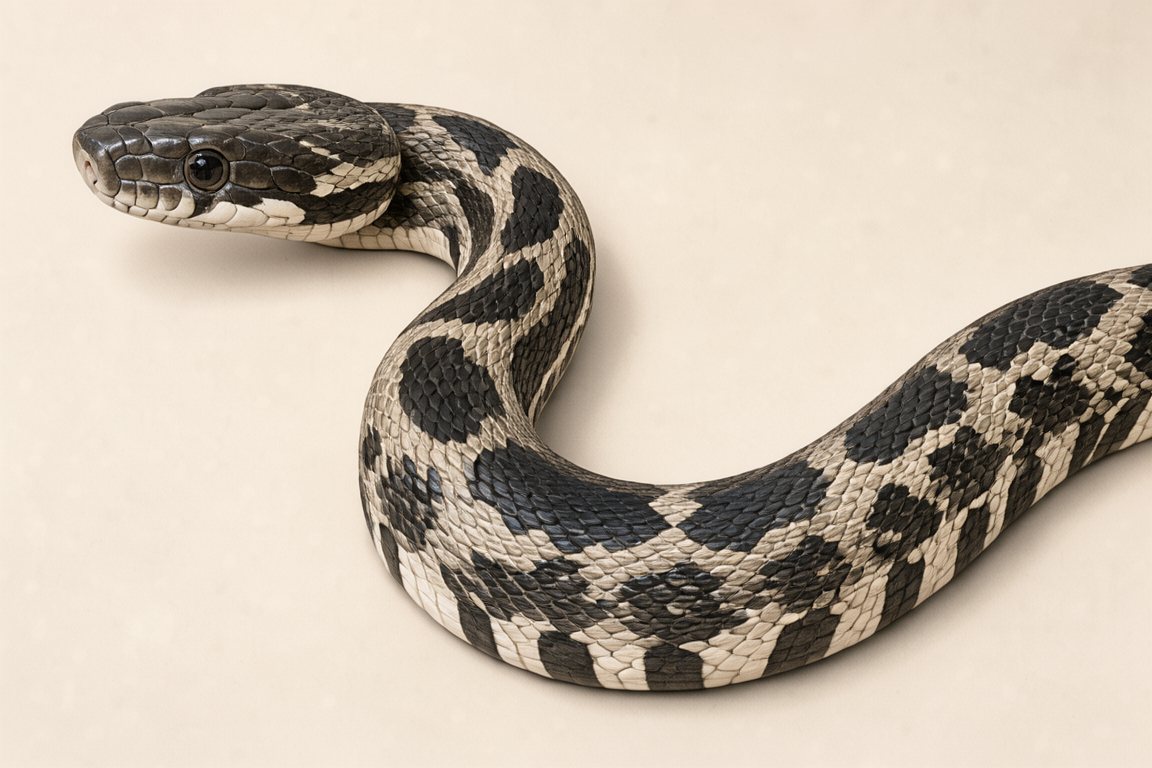
Pantherophis alleghaniensis is a medium-sized to large, slender and muscular rat snake with a rounded head and round pupils. Adults are normally 100-185 cm long including the tail, and the longest reach around 215 cm. Newly hatched young measure 25-30 cm.
The pattern depends on the range. In the north adults are uniformly black with a pale belly, often with a white chin and throat. Further south the animals keep the hatchling pattern throughout life: dark elongated blotches on a grey background, a pale grey crown with a dark line pointing forward like a spearhead, and a dark band through the eye. The belly is whitish or pale grey with dark, irregular spots. This is unusual in the genus, where the hatchling pattern otherwise disappears with age.
The delimitation of the species has changed several times. The genus name is Greek and means panther snake, and the species name refers to the Allegheny Mountains. After DNA studies, the old subspecies of Pantherophis obsoletus are now regarded as three species: P. obsoletus west of the Mississippi, a middle species between the Mississippi and the Appalachians, and Pantherophis quadrivittatus east of the Appalachians and in Florida. The middle species was first called Pantherophis spiloides, and P. alleghaniensis was used for the eastern one. It later turned out that the type specimen of P. alleghaniensis belongs to the middle group, so the name now applies to that one, and P. spiloides is a synonym. The same snake is therefore found in the literature and in the trade as Pantherophis spiloides, Elaphe obsoleta spiloides and Elaphe alleghaniensis, and older texts about P. alleghaniensis are often about the eastern species. The species interbreed where they meet, so animals from the border zones can be hard to identify. Ask the seller which delimitation the name follows. Care is the same for all three species.
The animals are active and strong. Captive-bred animals usually become calm with regular handling, but the species is more defensive than Pantherophis guttatus. There are a few morphs, but they are far rarer than in Pantherophis guttatus.
Distribuição e habitat
Pantherophis alleghaniensis lives in the eastern and central USA west of the Appalachians and east of the Mississippi. The range runs from south-western Wisconsin, Michigan, Illinois, Indiana and Ohio through Kentucky and Tennessee to the Gulf coast in Louisiana, Mississippi and Alabama and into the north-western part of Florida west of the Apalachicola River. To the north-east it reaches western New York, Pennsylvania and Maryland. The species also occurs in southern Ontario in Canada in two separate areas: on the north shore of Lake Erie and in the area between the Great Lakes and the St. Lawrence River.
To the west the species is replaced by Pantherophis obsoletus and to the east by Pantherophis quadrivittatus. Where the ranges meet, they interbreed, and the animals can be hard to identify.
Área de ocorrência natural: Estados Unidos e Canadá. Os pontos são registros do GBIF e podem incluir animais em cativeiro e populações introduzidas. Ver a espécie no GBIF
Habitat
Pantherophis alleghaniensis lives in deciduous and mixed forest, cypress forest, along hedgerows and watercourses, in fields and around barns and sheds. Almost any habitat with plenty of rodents and vertical escape routes suits the species. It climbs as well in the tree crowns as it moves on the ground and goes up into the trees to raid bird nests and squirrel nests. Females that are about to lay eggs often use hollow trees and rotting stumps.
The species is active by day in the cool spring and shifts to dusk and night in warm periods. It hunts by waiting, by pursuing prey and by raiding nests. It kills by constriction and mostly eats small mammals, birds and bird eggs. Newly hatched young and juveniles mostly take frogs and lizards. It has a large home range and returns to the same hunting areas. In cold regions it enters a winter rest, often in communal dens. The species is common over most of its range, but the two Canadian populations are threatened.
Cuidados
O terrário
An adult Pantherophis alleghaniensis needs an enclosure of at least 180 × 90 × 90 cm (length × width × height). The species is active and climbs, so height and climbing opportunities are important. Bigger is better, especially in height. The species must be kept singly.
Care is the same as for the close relatives Pantherophis obsoletus and Pantherophis quadrivittatus, and where figures for the species itself are missing, they are borrowed from P. obsoletus.
Hatchlings can live in a small enclosure or a ventilated box for the first few months but must quickly move to something larger. Furnish with at least two small hides, one at the warm end and one at the cool end, plus a humid hide for shedding. The hides should fit snugly around the coiled snake. Add sturdy branches, cork and shelves so that the snake can climb. For substrate use topsoil mixed with coconut fibre and a layer of leaf litter, or aspen shavings and cypress. Paper is cheap and clean but must be replaced completely every time the animal has made a mess. Avoid pine and cedar, whose oils can harm the snake. Remove faeces immediately.
The enclosure must have a lockable lid. The species is a skilful escape artist, and even small gaps can be too big. Use clips or locks. All surfaces must be smooth, so that the snake does not injure its snout if it rubs against the wall. A large enclosure helps against this.
Temperatura
There must be a distinct gradient, so that the snake can choose for itself. The basking spot under the heat source should be 29-32 °C, and the cool end 22-25 °C. At night the temperature may fall to 18-22 °C, and the heat is switched off. Use several halogen spots over the mesh lid, so that the whole coiled snake is warmed, and provide a basking spot where it can stretch out. Under a hide a heat mat can be added as a supplement, but it must always have a thermostat. Measure with digital probe thermometers: one at the basking spot and one at the cool end. Keep the heat source out of the snake's reach, so that it cannot be burned.
The species comes from an area with cold winters and tolerates a cool winter. Animals to be bred are kept for 8-12 weeks at 10-15 °C and in darkness or dim light. Animals not being bred can be kept all year round with 12 hours of light. In a room with windows, feeding may stop during the winter months.
Umidade e água
Humidity should be 50-70 %, lowest by day and highest at night. Mist as needed, and put moist sphagnum in the hide at the cool end. Extra humidity is especially important during shedding, which shows as dull scales, bluish eyes and the animal hiding away. Then provide a moist hide filled with sphagnum. A constantly wet substrate and stagnant air cause mould, so ventilation must be good, and there must always be a dry place.
A large, heavy water bowl with fresh water must always be available. The snake can lie in the bowl, so it must be large enough for that and not able to tip over. Change the water daily, and scrub the bowl when it is dirty.
Iluminação e UVB
Pantherophis alleghaniensis is active by day and at dusk and needs a distinct day-night rhythm with strong daylight. The light is on for about 12 hours a day, controlled by a timer. The species can live without UVB, but UVB is recommended because it benefits wellbeing. It belongs to Ferguson zone 2. Use a T5 HO tube of 5-6 % over the warm end, and aim for a UV index of 2-3 at the basking spot. With a tube over mesh, the distance from tube to the snake's back at the basking spot is about 25-30 cm, without mesh about 30-35 cm. Provide shade and hides in the rest of the enclosure. Replace the tube every 12 months, because the UV output falls even though the tube still lights up. If the enclosure stands by a window, it must never be in direct sun.
Alimentação
Pantherophis alleghaniensis eats whole, frozen and thawed rodents. Juveniles get mice, and in time they move on to rats. Quail eggs, quail chicks and small chicks give variety. Live prey is not recommended, because the rodent can injure the snake. The prey should be as wide as or slightly wider than the snake's widest point, but no more than 1.5 times as wide. Thaw the prey slowly in the fridge, warm it to about 38 °C and move it with tweezers, so that the snake does not confuse hand and food.
Some juveniles from the southern part of the range will only take mice once they have been scented with lizards or frogs. If so, rub the thawed mouse with a frozen lizard or a frozen tree frog, and try again. It usually works after a few feedings.
Juveniles are fed every 5-7 days and adults every 7-14 days. Weigh the animal monthly, and adjust the interval and prey size so that the weight stays steady. Captive-bred feeder animals can be low in vitamin D, so now and then lightly dust the prey with a calcium and vitamin supplement, especially without UVB.
Comportamento e manuseio
Pantherophis alleghaniensis is shy and prefers to avoid conflict, but defends itself when startled. It freezes with the body in wavy kinks, shakes its tail against the surface so that it rattles, raises its head and pretends to strike. If grabbed, it releases a foul-smelling fluid from the cloaca and bites if necessary. The bites are small and not dangerous, but unexpected. Captive-bred animals usually become calm with regular, gentle handling.
Let a new animal settle in for two weeks and feed regularly before it is handled. Lift it out of the enclosure with a snake hook, so that it does not confuse the hand with food, and then let it crawl from hand to hand without a hard grip. Take hold from underneath and support the body. Avoid squeezing or grabbing from above. Start with short sessions of a few minutes, and put the animal back when it is calm. Wait at least 48 hours after a meal, and do not handle the animal during shedding. Keep the animals separately. Stress from capture and restraint strains the animals, so do not handle animals that are nervous or shy.
Reprodução
Maturidade sexual e sexagem
Sex cannot be seen externally in hatchlings and is determined with a probe, which an experienced person or vet should use. Males grow faster and become larger than females. In the wild females reach sexual maturity after 7-9 years, and maturity depends more on size than on age. Age and weight in captivity are not documented. The female must be adult and in good condition before she is put to breed.
Acasalamento
In the wild the species mates from April to July. Males fight over females, and the male finds the female by scent and touch. Breeding normally follows a cool winter rest of 8-12 weeks at 10-15 °C, after which the animals are warmed up and fed well. Several males must not be put together, because they fight over the female.
Postura e ninhadas
The female lays 5-27 eggs from late May to July. The eggs are white and leathery. How many clutches a female can lay per year in captivity is not documented. In the wild females choose rotting stumps with high humidity and often lay communally. Give the female a laying box with moist sphagnum or vermiculite, and feed her generously afterwards.
Incubação
The eggs are moved to a box of moist vermiculite or perlite without being turned and kept in an incubator at 27-28 °C. The eggs hatch after about 65-70 days, and in the wild the young hatch in August and September. The young cut their way out with an egg tooth.
Criação dos filhotes
Newly hatched young measure 25-30 cm. They shed within the first week, before they eat. Keep them singly in small, secure enclosures with hides and water. Offer a small, newborn mouse every 5-7 days, and scent it with lizards or frogs if the hatchling will not eat. The young grow quickly, but must not be kept together, because the species can eat smaller members of its own kind.
Saúde e erros comuns
Pantherophis alleghaniensis is hardy, and most problems are caused by incorrect heat, humidity or handling. The typical mistakes are:
- Regurgitation if the snake is handled too close to a meal or gets cold. Leave it in peace for at least 48 hours after feeding.
- Poor shedding with skin remnants on the eyes and tail tip when the air is too dry. Provide a moist hide and a water bowl.
- Mites, which show as small black dots in the water bowl and on the snake. They require treatment and thorough cleaning of the enclosure.
- Respiratory infections with wheezing, mucus from the nose and mouth or an open mouth. They are often caused by too low a temperature or poor hygiene.
- Sores on the snout if the snake rubs against glass or mesh. A larger enclosure and smooth surfaces help.
- Injuries from unguarded heat sources or from live prey.
- Parasites in wild-caught animals: use captive-bred animals, and quarantine new animals. Mucus in the faeces, lethargy and lack of appetite can be signs.
A healthy animal has clear eyes, smooth skin and a firm grip. Contact a vet with reptile experience if the snake will not eat for several weeks, loses weight or has problems with breathing or the skin.
Pergunte sempre a quem entende do assunto
Este guia é um bom lugar para começar, mas não substitui a experiência. Os animais diferem, e boa parte do que mais importa se aprende com quem cria a espécie há anos. Converse com um criador, um tutor experiente ou um veterinário que conheça répteis e anfíbios antes de ter o animal - e de novo se algo parecer errado.
Fontes
- Pantherophis alleghaniensis (Holbrook, 1836). The Reptile Database
- Central ratsnake. Wikipedia
- Gray Rat Snake Care Sheet. Reptiles Magazine, 2015
- Black Ratsnake Care Sheet. ReptiFiles
- Texas Rat Snake Care Sheet. Reptiles Magazine, 2014