Deze gids is nog niet in het Nederlands vertaald en wordt daarom in het Engels getoond.
Robust velvet gecko
Amalosia robusta
Amalosia robusta is a sturdily built, nocturnal gecko from eastern Australia with pale spots on a grey or dark brown back and a flat, broad tail. It climbs on rocks and tree trunks and copes in both forest and the edges of towns. Its care is only sparsely described and is based on closely related species.
Over de soort
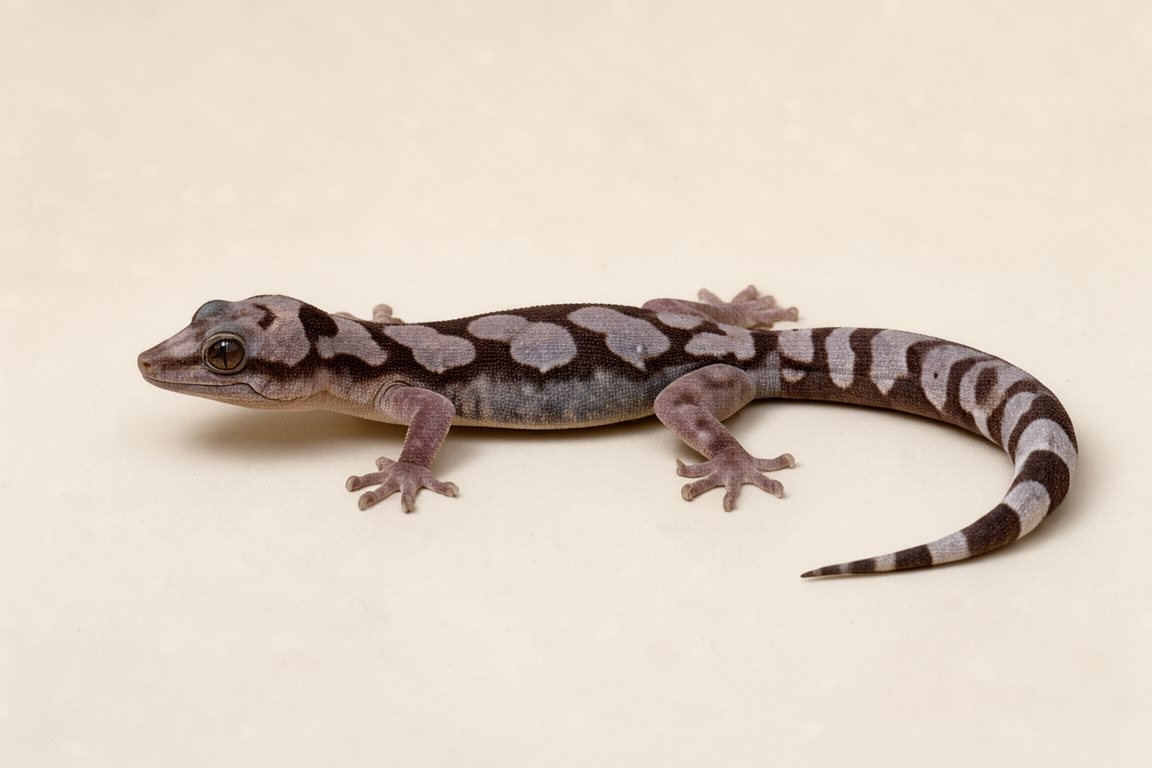
Amalosia robusta is a sturdily built gecko that grows to about 8 cm from snout to vent and 15-18 cm including the tail. The colour is grey to dark brown with pale, irregular spots across the back, and the pattern varies a good deal from animal to animal. The tail is flat and broad, especially when it has regrown. Fingers and toes end in broad adhesive pads that give grip on almost all surfaces, including glass. The eyes have no lids, and the gecko cleans them with its tongue.
The species was described in 1885 as Oedura robusta. In 2012 it was given its own genus, Nebulifera, "the cloud-bearer", after the pale spots on the back. In 2023 Nebulifera was merged with Amalosia, because genetically the species belongs among the genus's other species, and it is now called Amalosia robusta. It is the largest species in the genus.
The gecko is territorial. The males defend a hunting area and can fight so fiercely that loud, squeaking sounds are heard. If it bites when caught, the bite is weak and does not draw blood.
Verspreiding en leefgebied
Amalosia robusta lives in eastern Australia, from the coast around Newcastle and the inland south of Dubbo in New South Wales north to the coast around Rockhampton and the inland around Emerald in Queensland. Older records as far north as the Atherton Tableland are uncertain. The species is common in the outer suburbs of Brisbane, and a large population lives on the rock faces at Kangaroo Point in the middle of the city.
The range is large and continuous, and the species is not considered threatened.
Natuurlijk verspreidingsgebied: Australië. De stippen zijn waarnemingen van GBIF en kunnen dieren in gevangenschap en geïntroduceerde populaties bevatten. Bekijk de soort op GBIF
Leefgebied
Amalosia robusta is flexible and lives in warm temperate to subtropical forest and open woodland. It is found both on trees, where it sits under loose bark on eucalypts, and on rock ledges and in rock crevices. It also copes in remnants of nature inside towns and often moves into houses close to forest, where it sits behind shutters and under eaves.
The gecko is nocturnal. During the day it hides in crevices, and at night it hunts close to its hiding place. Its food is insects and other invertebrates, and it also licks plant sap and nectar. It is eaten by owls and other nocturnal birds, snakes and large spiders.
Temperature and humidity at the gecko's hiding places have not been measured. The climate is warm and humid in summer and mild and drier in winter.
Verzorging
Het terrarium
The care of Amalosia robusta is only sparsely described, and the figures in the guide are borrowed from the closely related Oedura castelnaui, Oedura monilis and Oedura tryoni, which live in almost the same way. A single adult needs a tall enclosure of at least 45 × 45 × 60 cm (length × width × height). A pair can be kept in 60 × 45 × 60 cm.
Furnish with cork bark, flat cork tubes and slanted branches, so the gecko can crawl in under something that presses lightly against back and belly. A back wall of cork or stone with crevices provides good hiding places, and a shelf with pieces of rock suits the species' natural habitat. A mix of unfertilised soil and sand, covered with dry leaves, is used as a substrate.
The enclosure should have good ventilation and a dry end. Lid and doors must close tightly, because the species climbs on glass and finds every gap.
Temperatuur
By day the enclosure should be 22-27 °C, and under a heat source at one end it can be 30-33 °C. At night the temperature may fall to 16-22 °C. A small heat mat under one corner or a low-wattage heat bulb on a thermostat is normally enough, and in a room at ordinary room temperature extra heat is often unnecessary.
In the cool months the hotspot can be lowered to about 30 °C, and the temperature in the enclosure must not fall below 15 °C. Measure with a digital thermometer at both ends.
Luchtvochtigheid en water
Humidity is kept at 40-65 %. Mist one half of the enclosure thoroughly every second day in summer, so the substrate dries out during the day, and keep it drier in the cool months. Place a shallow bowl of fresh water in the cool end. Constant moisture causes mould and skin problems.
The gecko readily drinks droplets from the walls.
Verlichting en UVB
The species is nocturnal and does not require UVB, but a weak UVB tube for shade-dwelling animals (Ferguson zone 1) over one side of the enclosure gives a more reliable calcium metabolism, as long as there is shade and cover. The day length follows the seasons: 12-13 hours in summer and 10-11 hours in winter, controlled by a timer. Do not use coloured night light or strong spotlights.
Lees meer: Licht en UVB Lees meer: Calcium, vitaminen en supplementen
Voeding
Amalosia robusta takes any suitable insect food: crickets, grasshoppers, cockroaches and small mealworms. Prey should be smaller than the distance between the eyes.
Adults are fed 2-3 times a week and subadults 3-4 times a week, and in the cool months feeding can be cut down to once every 7-10 days. Dust the food with calcium, and give a multivitamin 1-2 times a month. Insects that are not eaten are removed the next morning.
Gedrag en omgang
The species is territorial and is best kept singly or as a pair. Males must not be kept together. The animal is fast and can drop its tail, so it should not be handled more than necessary. Never grab the tail.
The gecko is an animal to look at. During the day it sits in its hiding place and emerges only when the lights are out. It can squeak loudly when it fights with others.
Kweek
Geslachtsrijpheid en geslachtsonderscheid
The male has distinct bumps at the base of the tail (hemipenial pouches) and pores in front of the vent. Age and weight at sexual maturity are not documented for the species. The females must be fully grown and in good condition before they are put into breeding.
Paring
The breeding season follows the warm months, from October to February, that is, the Australian spring and summer. The male is put into the female's enclosure and removed again if she chases him. A cool, dry period in winter helps condition and breeding.
Eileg en legsels
The female lays two parchment-shelled eggs per clutch. A new clutch follows every 4-5 weeks, 3-5 in all per season. Place a small plastic box with an entrance hole and 3-4 cm of damp sphagnum or coconut fibre in the enclosure. The eggs can lie in damp substrate for a few days without harm.
Incubatie
Carefully move the eggs, without turning them, to a small box of damp perlite or vermiculite and incubate them at 27-29 °C. At that temperature the eggs hatch after 60-65 days. Eggs that collapse and turn mouldy are infertile or dead. Whether temperature determines sex in A. robusta is not documented.
Opfok van de jongen
The juveniles shed within the first two days and begin to eat after five to eight days. Give tiny crickets dusted with calcium. Several juveniles can be kept together for the first 6-8 months, but the males must be separated as soon as the hemipenial bumps are seen. Juveniles are fed 3-4 times a week and moved to a larger enclosure when they are about half grown.
Gezondheid en veelgemaakte fouten
There is no species-specific documentation of diseases in Amalosia robusta. The typical problems in small, nocturnal geckos are:
- Too little calcium and vitamin D3, which causes soft jaws and bent legs. Dust the food.
- Constant moisture and poor ventilation, which cause fungus and skin problems.
- Remnants of old skin on the toes and tail tip. Provide a moist hiding place, and loosen the remnants with lukewarm water.
- Lost tail after handling or fighting. It is not dangerous, but the tail regrows in a different form.
See a vet with reptile experience if the animal loses weight, does not eat for several weeks or looks limp.
Vraag altijd raad aan iemand die er verstand van heeft
Deze gids is een goed beginpunt, maar kan ervaring niet vervangen. Dieren verschillen, en veel van wat er echt toe doet, leer je van mensen die de soort al jaren houden. Praat met een kweker, een ervaren houder of een dierenarts die reptielen en amfibieën kent voordat je het dier haalt - en opnieuw als er iets niet pluis lijkt.
Bronnen
- Amalosia robusta (Boulenger, 1885). The Reptile Database
- Amalosia Wells & Wellington 1984 (Hoskin & Couper 2023). Zootaxa 5343(4), 2023
- Revision of zigzag geckos (Diplodactylidae: Amalosia) in eastern Australia, with description of five new species. Hoskin & Couper, Zootaxa 5343(4), 2023
- Robust Velvet Gecko. Toohey Forest Environmental Education Centre
- Nebulifera robusta (Boulenger, 1885). GBIF
- traitdata: lizard_traits (Meiri 2018, Traits of lizards of the world). GitHub, 2018
- Jewelled Velvet Gecko (Caresheet). Livefoods
- Southern Spotted Velvet Gecko (Caresheet). Livefoods