Deze gids is nog niet in het Nederlands vertaald en wordt daarom in het Engels getoond.
Bibron's Agama
Agama bibronii
Agama bibronii is a medium-sized, diurnal rock agama from Morocco and the neighbouring parts of Algeria and Western Sahara. In the breeding season the male has a coppery orange head and a bluish purple body. The species needs a spacious, dry enclosure, a very warm basking spot, strong UVB and cool nights. Little is known about its care.
Over de soort
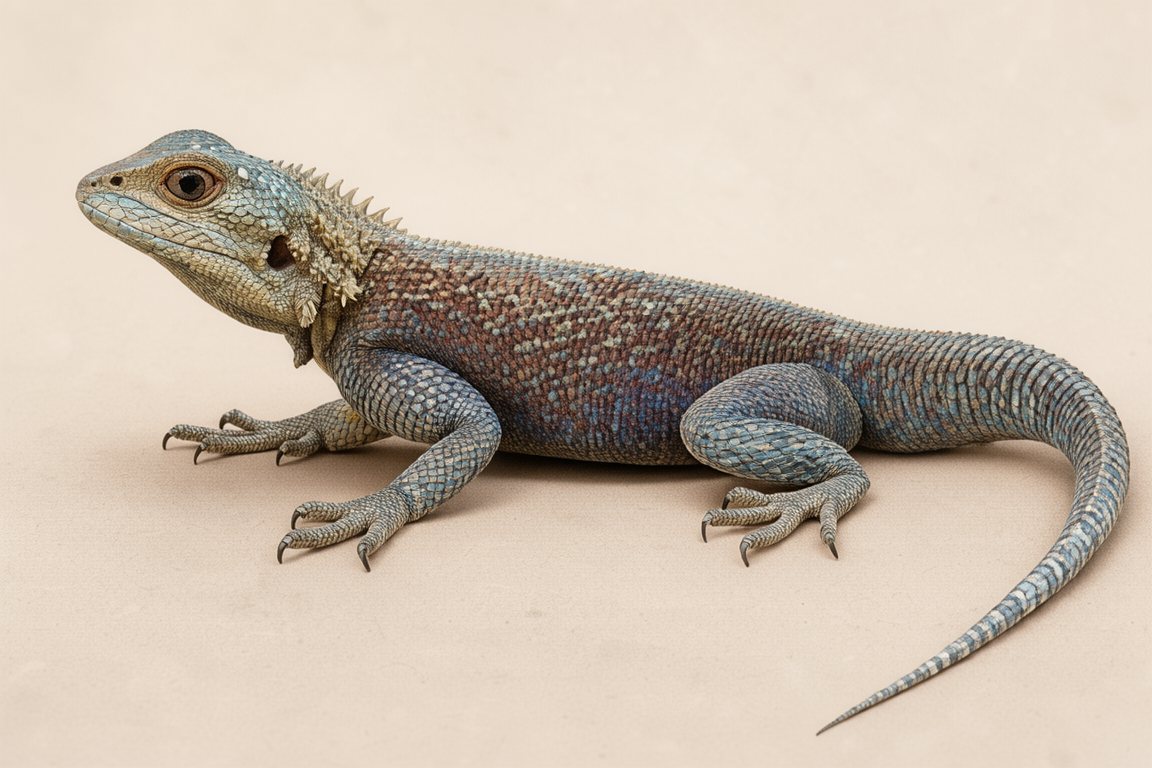
Agama bibronii is a slender, medium-sized agama with a thick tail, a large head and clusters of spines by the ear and on both sides of the neck. The dorsal scales are uniform in size and strongly keeled, and the throat is folded. Adults reach 25-30 cm including the tail, about half of which is tail. Males are the largest and have a broader crest and a row of pores in front of the vent.
The colours vary a great deal and change with temperature, sun, age and mood. Juveniles are grey to bluish grey with small knobs where the spines will later develop. In the breeding season adult males are coppery orange on the head and forebody, with a bluish purple hindbody and pale rings on the tail. Females are mainly bluish grey with an orange-yellow back and red stripes. The marked difference between the sexes makes adults easy to tell apart.
The valid name is Agama bibronii Duméril, 1851. For many years that name was thought to be preoccupied by another agama, so the species was listed as Agama impalearis Boettger, 1874. Since 2021 it has been established that the older name was not preoccupied, so A. impalearis is an unnecessary replacement name and therefore a synonym. The younger name is still used in many catalogues and in the trade, but it is the same species. Genetic studies suggest two distinct lineages, one north and west of the Atlas Mountains and one south and east of them, which may be two species. Animals of unknown origin should therefore not be interbred.
The species is fast and wary and is not an animal for handling. It climbs confidently on vertical rock, runs fast and immediately seeks cover. A tail that breaks off does not regenerate. No lifespan in captivity has been documented; 10-15 years is borrowed from Agama agama.
Verspreiding en leefgebied
Agama bibronii lives in Morocco, Western Sahara and northern Algeria. To the east it has been found as far as Batna Province. It may also occur in northern Mauritania, but this is unconfirmed, and the country is not shown on the map. The range is centred on Morocco, where it is among the commonest reptiles.
The species has also been mentioned from southern Spain, but the record is uncertain and is not shown on the map. Records further south and east in the Sahel belong to other species of Agama, including Agama agama.
Natuurlijk verspreidingsgebied: Marokko, Westelijke Sahara en Algerije. De stippen zijn waarnemingen van GBIF en kunnen dieren in gevangenschap en geïntroduceerde populaties bevatten. Bekijk de soort op GBIF
Leefgebied
Agama bibronii occurs in almost every landscape from humid to arid areas, but is most abundant in rocky terrain. It lives on stone walls, rock piles, rocky outcrops and at the edges of cultivated fields, and where there are no rocks it uses hollow trees. It is rare in the Sahara proper.
The species is diurnal and basks a great deal, especially in spring and autumn. In the middle of the day in summer it retreats into the shade or down into its burrow. The male stays on a rock or pile of stones overlooking his territory of 100-500 m². At night and when in danger the animal retreats into a burrow under a rock, an earth bank or a rodent burrow.
The diet is mainly arthropods such as spiders, beetles and ants, but small lizards and flowers are also eaten. The flowers provide moisture where rainfall is scarce. Mating begins in spring and continues through the summer; about a third to half of the females lay two clutches a year. The female lays her eggs in moist soil at a depth of 5-10 cm.
Verzorging
Het terrarium
Little is known about the care of Agama bibronii. The species is rare in captivity, but has been bred over several generations. The dimensions and temperatures given here are borrowed from Agama agama, which is similar in size and lifestyle, and adapted to the climate of this species: dry, sunny and with cool nights.
An adult needs an enclosure of at least 120 × 60 × 60 cm (length × width × height). A larger one is a good choice. The species is a fast climber, so a large floor area and several levels of rock and cork will be put to full use. Keep a male alone or with a female, and never house two males together.
Use a substrate of sand mixed with a little soil, 5-8 cm deep, so the animal can dig and has somewhere to hide. Avoid very fine, dusty sand. Furnish with flat, stable rocks, stacks of slate and cork so the animal can climb up and keep watch. At least three hiding places in different temperature zones is a good starting point. Everything must be firmly secured, as the animal is energetic and will bury things. The lid must be lockable, because the animal is very fast. Remove uneaten insects before the lights go out, and replace the sand completely every 3-4 months.
Temperatuur
A. bibronii needs a clear gradient. The basking spot should have a surface temperature of 38-43 °C, measured with an infrared thermometer. The rest of the enclosure is 24-32 °C. Use a halogen spot over a flat rock or slate slab, and put a thermostat on every heat source.
At night the lamps are switched off and the temperature should drop noticeably, to 16-20 °C. The night temperature has not been documented for the species; the figure suits a dry climate with cool nights. If the room is colder, use a ceramic heater on a thermostat, which gives no light.
In winter the species becomes less active in the wild, especially the adults, but a true winter rest has not been documented. If the temperature is to be lowered in winter, do it gradually and only with a healthy, well-nourished animal.
Luchtvochtigheid en water
Humidity should be 30-50 %. Agama bibronii comes from arid to semi-arid regions, so the enclosure should be dry, with good ventilation. Mist the walls lightly one or two mornings a week; the animal readily drinks droplets. Also place a shallow dish of fresh water in the enclosure, and change the water daily.
Air that is too dry causes problems with shedding, especially on the toes and tail tip. Damp combined with cold causes respiratory infections.
Verlichting en UVB
A. bibronii is diurnal and basks all day, so it needs strong light and UVB equivalent to Ferguson zone 3. This is borrowed from Agama agama, but suits the open, sunlit habitats of the species. Use a 10-12 % T5 HO tube in a reflective fitting over the basking spot and the warm part of the enclosure. The distance from tube to basking spot is normally 25-40 cm depending on the mesh and the lamp; check with a UV meter. The cool end should have shade so the animal can withdraw.
Provide 12-14 hours of light a day controlled by a timer. UVB tubes lose their output long before the light visibly weakens, so replace them according to the manufacturer's instructions, usually every 12 months.
Voeding
Agama bibronii is primarily an insectivore. Offer a varied diet of well-fed insects: cockroaches, crickets, locusts and, in smaller amounts, mealworms and superworms. Fatty insects such as waxworms are for treats only. The insects should be no larger than the distance between the animal's eyes. Offer a little greenery and flowers each week, such as dandelion leaves and flowers, but not lettuce and spinach as a staple.
Juveniles are fed daily. Adults get insects three times a week so they do not become fat. Remove uneaten insects before the lights go out.
Dust the insects with calcium without D3 at every feed when the UVB lighting is in order, and give a vitamin supplement with D3 every other week. If the UVB lighting is inadequate, use calcium with D3 at every other feed, but this cannot replace UVB. Feeding amounts and diet types are borrowed from A. agama.
Lees meer: Calcium, vitaminen en supplementen
Gedrag en omgang
A. bibronii is fast, wary and territorial. Males defend an area with threatening postures: they raise the body, bob with the forelimbs, flare the throat and lash with the tail. Never keep two males together. A male can be kept with a female in a large enclosure with many hiding places, but the male is persistent in the breeding season, so the female must be able to avoid him.
The animal does not seek contact and is not suitable for daily handling. If caught, it may play dead and then flee. Never grab the animal by the tail. A tail that breaks off does not grow back. An animal with good hiding places is calmer and shows more colour.
Kweek
Geslachtsrijpheid en geslachtsonderscheid
The male of Agama bibronii is larger, has a broader head and a taller crest than the female, and has a row of pores in front of the vent. Adults can be recognised by their colours; juveniles are harder to sex.
Females can breed as early as their first year, but most breed at 1-2 years old. Do not put a female into breeding until she is fully grown and in good condition.
Paring
In the wild mating takes place in spring and summer. Introduce the male to the female in a large enclosure with many hiding places, so the female can avoid him. The male approaches in circling movements, the female arches her back and lifts her body and tail, and the male grips her by the neck. Watch the female, and separate the animals if she gets wounds or stops eating.
Eileg en legsels
A gravid female becomes noticeably rounder. Give her a laying box with 10-15 cm of well-moistened sand or soil, where she can dig a hole of 5-10 cm. A clutch is 5-23 eggs, on average about 14, and large, older females lay the most. A female can lay two clutches in a season. The female goes down into the laying box, lays the eggs and leaves them.
Without a suitable site the female may retain the eggs, and this can become life-threatening. Give her plenty of food and calcium before and after laying.
Incubatie
Lift the eggs out carefully without turning them. Place them in slightly moist vermiculite or coconut fibre in an incubator at 28-32 °C. At 28 °C the eggs hatch after about 67 days, at 32 °C after 41-46 days. The hatching rate is highest at 28-34 °C and low at 26 °C and 36 °C; at 20 °C the eggs do not hatch. At 26 °C and 36 °C all the young are female.
Sex is determined by incubation temperature: at 28 °C only about 10 % are male, at 30 °C about half and at 32-34 °C 30-60 %. The largest young are obtained at 28-32 °C. Keep the temperature stable.
Opfok van de jongen
Keep the young apart from the adults in an enclosure with the same furnishings, many hiding places and UVB. The young have small knobs where the spines will later develop. Feed daily with small insects dusted with calcium. Separate the males from one another in good time, as they become territorial. Growth and time to sexual maturity have not been documented in captivity.
Gezondheid en veelgemaakte fouten
Most illnesses in Agama bibronii are caused by mistakes in care. Typical problems are:
- Metabolic bone disease from too little UVB and calcium. The signs are tremors, soft limbs and deformed jaws.
- Shedding problems in air that is too dry, especially on the toes and tail tip, where old skin can constrict the blood supply.
- Respiratory infection from too low a temperature or too high humidity: wheezing breathing, mucus at the nostrils and an open mouth.
- Obesity from too many fatty insects and too little exercise.
- Intestinal worms and other parasites. Wild-caught animals often carry many, so quarantine new animals and have a faecal sample examined.
- Egg-laying problems in females without a suitable laying site.
A healthy animal has clear eyes, a plump tail and smooth skin without old shed, and it eats willingly. Reptiles hide illness for a long time, so contact a vet experienced in reptiles if the animal loses weight, does not eat, breathes with its mouth open or seems lethargic.
Vraag altijd raad aan iemand die er verstand van heeft
Deze gids is een goed beginpunt, maar kan ervaring niet vervangen. Dieren verschillen, en veel van wat er echt toe doet, leer je van mensen die de soort al jaren houden. Praat met een kweker, een ervaren houder of een dierenarts die reptielen en amfibieën kent voordat je het dier haalt - en opnieuw als er iets niet pluis lijkt.
Bronnen
- Agama bibronii DUMÉRIL, 1851 (synonym: Agama impalearis). The Reptile Database
- Agama impalearis Boettger, 1874. GBIF
- Agama bibronii. Wikipedia
- Ficha de Agama bibronii. Moroccoherps, 2022
- Effects of incubation temperature on embryonic development and sex determination in the North African agamid lizard, Agama impalearis. The Herpetological Journal, 2001
- Red Headed Agama Care Guide (lånt art: Agama agama). Reptile Direct, 2026